
An Introduction to Ground Stone Tools - Speakers Richard Fullagar & Judith Field
Abstract
Part 1. Classification, traceology and function
Richard will discuss work on the classification and function of ground stone tools (GSTs), as articulated in the book (in progress) on Aboriginal ground stone implements. He will focus on a chapter about a convenient typology of ground stone implements for the Murray Darling Basin. Many of these implements have been assessed in studies of form, function, technology, use wear and residues. There are about 25 tool types documented by Colin Pardoe, with morphological and functional variables in a classification system relevant to understanding GSTs being recorded elsewhere in Australia and Papua New Guinea.
Part 2. Ancient Starch Residues and the potential for insights into past plant use.
Judith will present a basic introduction to the study of ancient starch (and perhaps other residues) related to use. Unlike pollen or phytolith studies, ancient starch (where it is preserved), can be quite challenging to identify and/or attribute to a plant taxon. Determining whether it is worth going down this track when evaluating a ground or flaked stone assemblage requires consideration of a variety of factors. Providing .insights into starch analysis on stone tools from Australia and PNG may help practitioners in deciding if it can be included in their research design.
About the Presenters
Richard Fullagar
 Richard is an Australian archaeologist who has published widely on the function of stone tools from key sites spanning early modern human dispersals, mostly in southeastern Asia and the Australian region. His first job was with the Victoria Archaeological Survey (1978–1982). His main interests are how stone tools were used and the history of human dispersal, behavior and subsistence. He is currently an Adjunct Professor involved with Australian Research Council projects led by researchers at University of Western Australia (Desert to the Sea: Managing Rock Art, Country and Culture), Flinders University (Rockshelters and Rock Art in the River Murray Gorge) and La Trobe University (Lake Mungo). He is currently writing (in collaboration with Colin Pardoe and Elspeth Hayes) a comprehensive book on Australian Aboriginal ground stone tools.
Judith Field
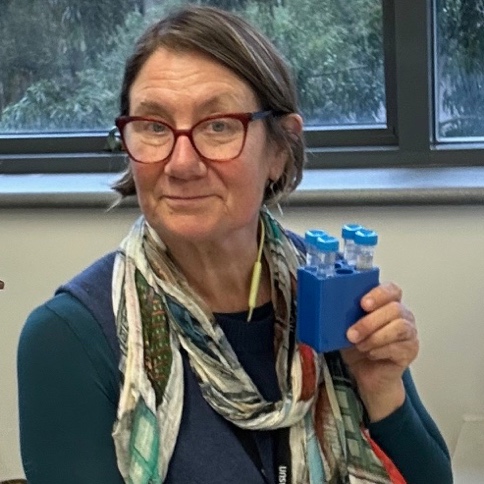 Jude has been working on ancient starch residues since her PhD studies, and with Richard Fullagar, we discovered some very old grinding stones (c.30,000 years) at Cuddie Springs in western New South Wales. Since then Jude has been looking for ways to both identify the starch grains to plant taxa and establish a quantitative approach to the problem. A collaboration with Applied Mathematician Professor Adelle Coster at UNSW began with the application of Geometric Morphometric analyses of traced starch assemblages to better understand variations in shape and size across genus and species. These studies have developed and changed over the last decade. The results of these analyses have allowed us to identify plant taxa in archaeological assemblages from a range of environmental settings and ages. It continues to be both time consuming and challenging. We now have over 39,000 individually traced starch grain images from archaeological and comparative reference collections…. and the investigations continue.
About Archaeology Working Papers
The Working Papers in Archaeology seminar series provides a forum for dissemination of archaeological research and ideas amongst UQ archaeology students and staff. All students are invited to attend the series and postgraduate students, from honours upwards, are invited to present their research. The aim is to provide opportunities for students, staff and those from outside UQ, to present and discuss their work in an informal environment. It is hoped that anyone interested in current archaeological directions, both within and outside the School and University, will be able to attend and contribute to the series.
