
Bending kastom to save kastom: preserving Solomon Islands' last surviving pottery making tradition
Please note that Dr Radclyffe will present their paper online, but we will have a room available for those on campus.
Abstract
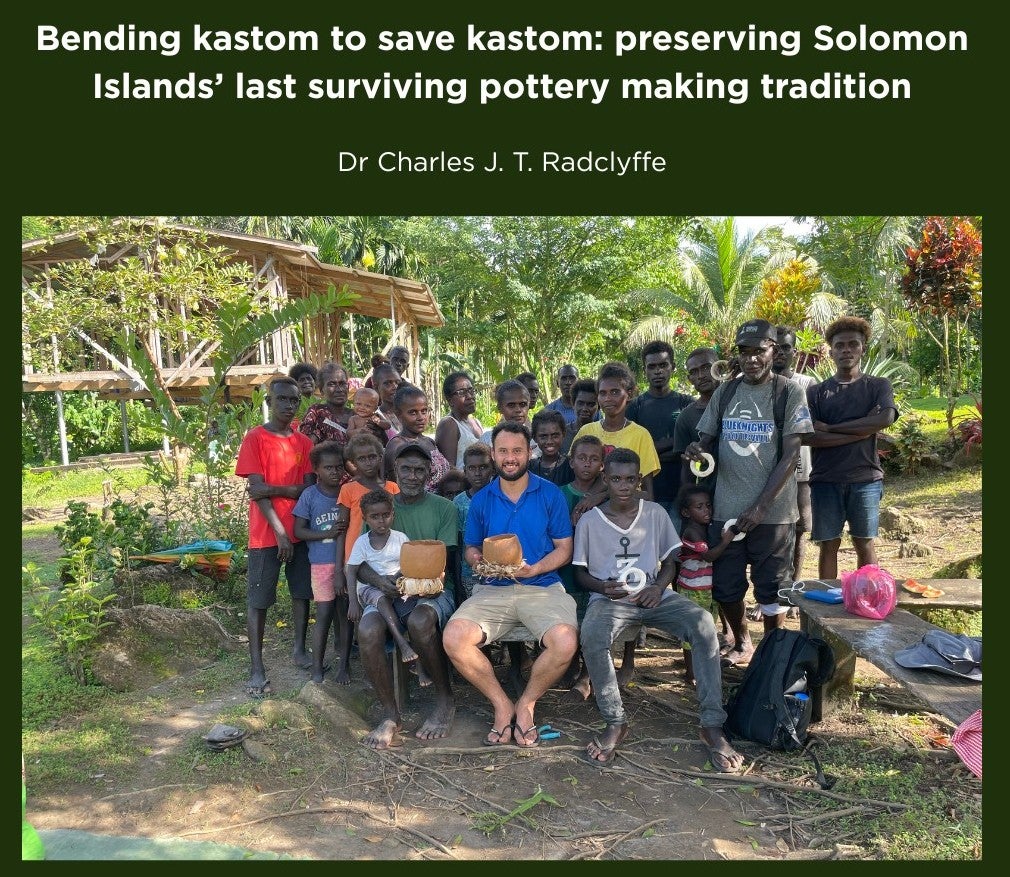
How far can kastoms (Pijin term, referring specifically here to ‘traditional material practices’) be bent - altered or reshaped - while upholding their cultural integrity and connectedness to place, people and identity? What role can archaeological and anthropological research play in helping indigenous communities negotiate and navigate this? This paper presents reflections from the researcher and insights from an ethnoarchaeological documentation project of Solomon Islands’ last surviving pottery making tradition. First introduced to the archipelago about 3000 years ago, the tradition, known locally as sereke pua, is survived by a small group of women in the village of Sirovanga, northwest Choiseul, one of Solomon Islands' nine provinces. The potters receive little governmental support and recognition, in contrast to more vibrant and highly visible cultural-tourism supported traditions of shell money making and carving, for example. Key challenges and threats facing the documentation and preservation of sereke pua will be discussed, including village-wide and family politics of 'ownership' of the tradition, the notion of authenticity, and competition over monetary benefits. Additionally, pathways set out as part of the ongoing project to addressing these challenges will be shared that may be useful for other community-centred cultural preservation or revitalisation research.
About the Presenter
Dr Charles J. T. Radclyffe
Dr Charles James Tekarawa Radclyffe (Kiribati and British ancestry) is an anthropological archaeologist and is the University of Otago Archaeology Programme's first appointed lecturer of Pacific descent. Born and raised in Solomon Islands, his research focuses largely on the indigenous cultural heritage (kastoms) and deep past of the culturally diverse and understudied archipelago. Through research collaborations, conferences, consultancy work (Everick Heritage), volunteering and his current position, he has also carried out archaeological work and qualitative anthropological research in Aotearoa, Australia, Papua New Guinea and the United Kingdom. His key areas of research include archaeological modelling of human settlement of Oceania, investigating exchange systems and how they have changed over time, and broader notions of land and identity. Recently, his research has centred on the history and vulnerability of material knowledge systems such as pottery making in Solomon Islands (publishing in both Solomon Islands Pijin and English), decolonising archaeology, improving public accessibility to academic research, and navigating the management, protection and preservation of cultural heritage in plural legal systems.
About Archaeology Working Papers
The Working Papers in Archaeology seminar series provides a forum for dissemination of archaeological research and ideas amongst UQ archaeology students and staff. All students are invited to attend the series and postgraduate students, from honours upwards, are invited to present their research. The aim is to provide opportunities for students, staff and those from outside UQ, to present and discuss their work in an informal environment. It is hoped that anyone interested in current archaeological directions, both within and outside the School and University, will be able to attend and contribute to the series.
Venue
Please note that Dr Radclyffe will present their paper online, but a room is available for those on campus.